No judgment
No Exposure
Share & Heal
What If You Could Share Without Fear of Judgment?
Imagine a space where your deepest struggles are shared in complete anonymity, with people who truly understand—no judgment, no exposure.
Do Even the Most Powerful Feel Alone?
Even the most powerful individuals carry unseen loneliness. In today’s fast-paced, disconnected world, we often feel more alone than ever.
Looking for a Place to Connect, Share, and Heal?
Mithrarya offers a refuge—a place to connect, share, and heal. Here, there’s no pressure to be perfect—only the opportunity to be understood.
Where Loneliness Finds Companionship?
At Mithrarya, your loneliness meets companionship, and your journey toward healing begins
Mithrarya: A Lifeline for Authentic Connections
Mithrarya isn’t just a platform; it’s a lifeline, inspired by the soulful connections of peer group church meetings. In this space, vulnerability transforms into strength.

Mithrarya
In a world where connection seems more digital than human, Mithrarya gives you a space to share your deepest struggles anonymously-no judgment, no exposure. Vulnerability becomes strength when you find people who truly understand.
Be the First to Join Mithrarya
Join the Waitlist Today!
By signing up, you’ll:
★ Get exclusive
early
access to
Mithrarya before anyone else.
★ Help shape the future of our
platform with
your
feedback.
★ Be part of a community that values empathy, privacy,
and
support from
day one.
Be the First to Join Mithrarya
Join the Waitlist Today!

About me
In 2018, I arrived in the U.S. with no support network and a determination to rewrite my
story. From teaching myself English to earning a master’s and pursuing a PhD, with a
strong foundation in statistics, I’ve navigated challenges that strengthened my resolve.
As a professional pianist and academic, I blend creativity, data analysis, and activism
to amplify marginalized voices. This journey inspired me to create Mithrarya-a platform
that connects and empowers through shared experiences, proving that resilience can lead
to innovation.
Read more
About me: My Journey from Immigrant to Innovator

As an immigrant woman who arrived in the U.S. in 2018, I know firsthand the power of resilience and self-empowerment. Entering this country with no support network, I took on the challenge of creating my own path in a world that often underestimates the strength of women and minorities. My journey has been a testament to the perseverance of those who are marginalized but refuse to be silenced.
The first step was learning English—something I did independently, knowing that mastering a new language was essential to my success. Shortly after, I earned my Master’s degree in Ethnomusicology and Social Anthropology from Kent State University, Ohio, and was honored to be nominated as the best international student in 2019. My achievements culminated in receiving an admission letter for my PhD from Indiana University Bloomington, home to one of the nation’s top programs in Ethnomusicology and Applied Anthropology.
I proudly stand on the intersection of academia and activism, with my academic skills deeply rooted in both quantitative and qualitative research. My bachelor’s degree in Statistics provides me with a robust foundation in data analysis, problem-solving, and critical thinking—tools that I have leveraged to challenge societal norms and empower marginalized voices. In my PhD research, I apply ethnographic methodologies to uncover hidden narratives, designing effective questionnaires and interviews to explore the lived experiences of diverse communities.
But my story is not just about academic achievements; it is also about life skills that are rarely taught but are essential for survival as a woman, an immigrant, and a minority in this world. My journey has fortified my resilience, resourcefulness, and fierce self-determination—qualities that all women possess but are often undervalued. I have navigated a new culture, often in spaces that were not designed for me, and I’ve emerged stronger, more adaptable, and deeply empathetic to those who, like me, have had to carve out a space for themselves.
I am also a professional piano player, a skill that deepens my creativity and connects me to an expressive world beyond academia. For me, playing the piano is a form of resistance—an act of reclaiming space and voice in a society that tries to confine who I am. This powerful blend of academic excellence and artistic creativity has fueled my innovation, culminating in the creation of Mithrarya, a platform that seeks to uplift and connect individuals through shared experiences.

The Inspiration Behind Mithrarya
As an immigrant, alone women, I found solace in peer support groups to
break the isolation, but I couldn’t ignore those without access—people facing
disabilities, social anxieties, or overwhelming responsibilities. That’s when Mithrarya
was born. Inspired by my own struggles, it is a safe, anonymous space where anyone can
find support, anytime, anywhere. What started as my personal challenge has grown into a
solution for all—connecting and empowering voices that need to be heard.
Read more
The Inspiration Behind Mithrarya

During my immigration journey, I faced the harsh realities of being alone in a new country, navigating not just the language barrier but also the emotional challenges of isolation. As an immigrant woman, I found solace in peer group sessions held at local churches in Kent, Ohio, where individuals gathered to share their struggles, experiences, and triumphs. These sessions were a lifeline—one of the few places where I could openly express myself, feeling heard and validated. However, even while benefiting from these groups, I couldn’t ignore a deeper realization: What about those who don’t have access to these spaces? What about people who, for various reasons, can’t attend or struggle to participate?
For many, attending these in-person meetings isn't just a matter of willingness; it’s about feasibility. What happens to those who have physical disabilities that make leaving home difficult or impossible? For them, the idea of showing up at a meeting may not be an option at all. What about those with mental health challenges or social anxiety, who fear being judged or misunderstood in public settings? These individuals deserve support and connection, but traditional group meetings often present obstacles that are hard to overcome.
Furthermore, these church-based in-person peer groups aren’t always accessible when people need them the most. Sessions might only happen once a week, during specific hours, requiring a commitment of time to travel and meet others. For people juggling work, family, and other responsibilities, this can be yet another barrier to receiving the help they need. This was a constant frustration for me: I often felt that the timing or location didn’t align with when I truly needed support.
These questions led me to realize the deep need for a space that could provide the same support and empathy, but without the limitations of geography or the fear of judgment. I saw a gap—a global need for a platform where people could connect through shared experiences, without the pressure of being seen or known. What if people could open up anonymously, free from societal expectations and without the fear of exposing their identities? What if we could create a space where vulnerability became a strength rather than a source of shame?
That’s where Mithrarya comes in. With Mithrarya, the support system isn’t bound by physical or time-based limitations. It’s always accessible, for everyone, no matter where they are or what time it is. In less than a minute, anyone can log in and find a person or a group who understands what they’re going through, anonymously and without fear of judgment. There’s no need to wait for the next scheduled meeting or to overcome physical or emotional hurdles to show up in person. Mithrarya is there when traditional systems fall short, offering instant, real-time connection to people who share similar experiences and challenges.
This platform is designed with inclusivity at its core, ensuring that those who may struggle to participate in physical spaces, such as individuals with disabilities or those with demanding schedules, are never excluded. By removing the barriers of location, time, and fear of exposure, Mithrarya provides an immediate and accessible space where support is always available.
The Creation of Mithrarya
Mithrarya was born from a simple but profound realization: countless people are isolated
by barriers like geography, social fear, or physical limitations. This global platform
offers a safe, anonymous space where anyone, no matter their background, can share their
struggles without fear of judgment. It’s more than an alternative to in-person
meetings—it’s a lifeline for those who’ve been left behind by traditional support
systems. Mithrarya is a refuge for the unheard, empowering individuals to connect, heal,
and thrive.
Read more
The Creation of Mithrarya
The questions I faced during my immigration journey—what about those who don’t have access to peer support?—became the driving force behind the creation of Mithrarya. As a woman who has personally encountered challenges and inequalities in society, I am deeply aware of how difficult it can be for people, especially minorities, to find a space where they are understood and supported without bias. However, I wanted Mithrarya to be a platform for everyone—a virtual space that allows all people, regardless of background, to connect based on shared experiences. Mithrarya was designed to break down the barriers of geography, social discomfort, and fear of judgment, while providing an equal place for everyone, especially those who often face additional obstacles.
Mithrarya is a global platform, allowing individuals to connect through their common challenges, with the key element of anonymity. I recognized that many people, especially those who have been marginalized or face societal pressure, may fear being judged or misunderstood. Anonymity enables people to open up without worrying about exposing their identity or personal details. This encourages honesty and vulnerability, creating more meaningful connections among users.
By offering an anonymous and safe environment, Mithrarya helps people connect freely, without fear of judgment. Users can openly share their struggles and challenges without worrying about who might see or know them. Whether someone is navigating mental health challenges, trauma, or social isolation, they can find the support they need on Mithrarya.
Mithrarya fills a global need, providing a space for people who may not have access to traditional peer support groups. Many individuals, whether due to geographical constraints, disabilities, or social fears, cannot attend in-person meetings. For minorities, such barriers can be even more pronounced. Mithrarya offers an alternative—an online, flexible, always-accessible platform where users can feel safe, supported, and empowered to share their experiences.
Mission & Impact

Validating Mithrarya
To ensure Mithrarya served real needs, I spent a year interviewing 300 people—280 of whom were eager for a platform offering anonymous support. This response made it clear: Mithrarya wasn’t just an idea, it was a necessity. I invested my own PhD stipend to bring it to life, transforming this vision into a reality. Today, Mithrarya is a thriving space where people can connect, heal, and find the support they deserve. “Mithrarya has been a lifeline for me. I never thought I could open up, let alone anonymously, and find people who understand me without judgment.” – Sarah, early user
Open PopupValidating Mithrarya

After the concept of Mithrarya was born, I knew that validating this idea was essential to ensure that it would resonate with people and truly meet their needs. Over the course of a year, I embarked on a journey to test the potential impact of this platform by interviewing approximately 300 people from various backgrounds. I wanted to hear directly from individuals to understand whether a virtual space that allows people to connect anonymously, based on shared experiences and challenges, was something they would use.
During these interviews, the response was overwhelmingly positive. More than 280 participants expressed genuine enthusiasm for the concept of Mithrarya. People from all walks of life shared how they often felt isolated or afraid to open up about their struggles in traditional support settings. The idea of connecting with others who had faced similar challenges, without the fear of judgment or exposure, resonated deeply with them. It became clear that Mithrarya had the potential to fill a significant gap in the way people seek support and connection.
Despite the challenges of developing a startup while pursuing my PhD, I was committed to bringing Mithrarya to life. I used my personal funds, saving part of my PhD stipend to create the first sample of the website. This was not only a financial investment but also an expression of my belief in the power of this platform. It was a risk, but one I felt was necessary to prove the concept and create a foundation for future growth.
By using my own resources and dedicating myself to building Mithrarya, I demonstrated my commitment to this project. It was more than just an idea—it was a mission to create a space for people around the world to find support and connection, particularly those who are often left behind by traditional systems. Mithrarya has evolved from an idea into a real, tangible platform, and I continue to invest my time, energy, and resources into making it a success.
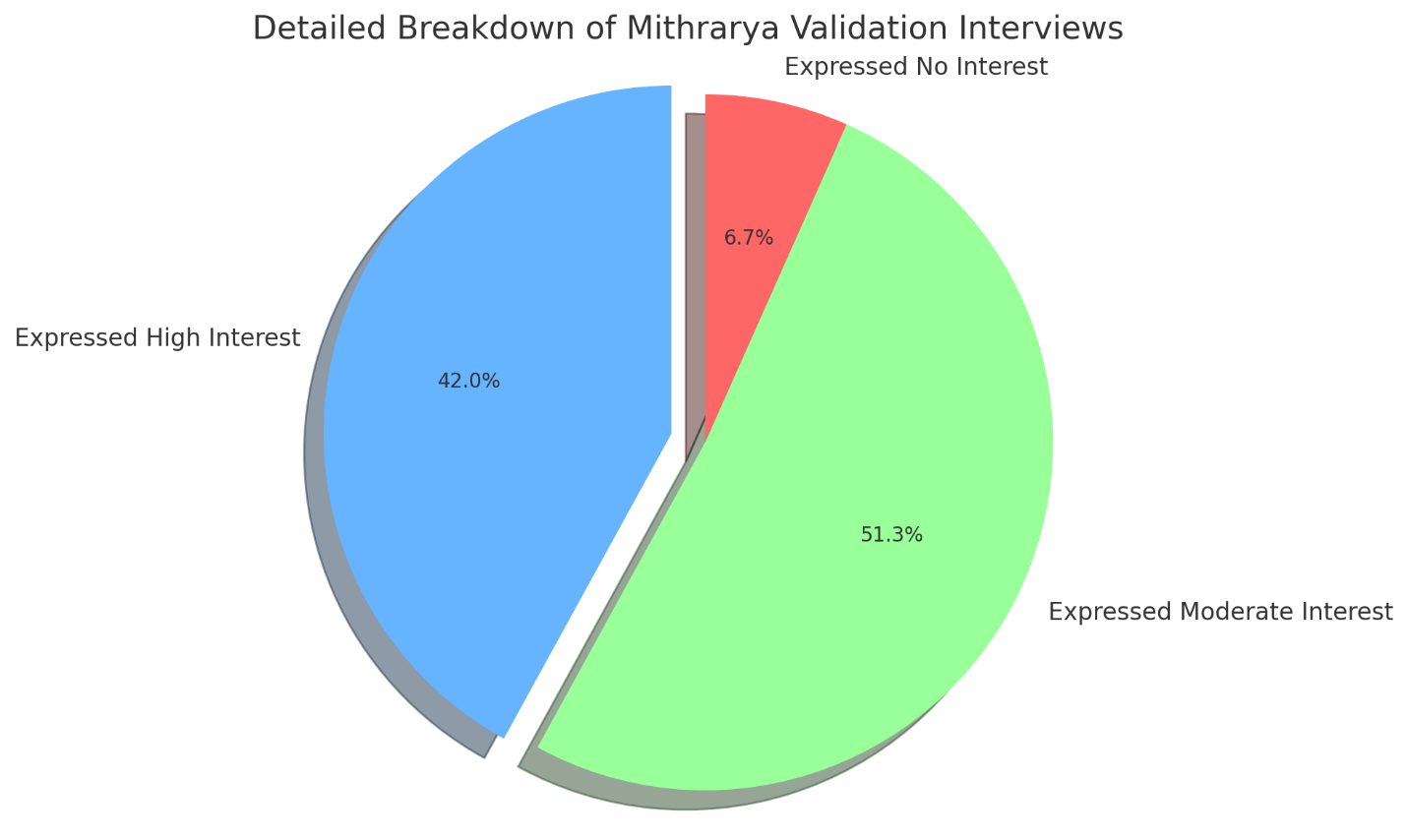
This pie chart represents the feedback from approximately 300 individuals interviewed during the validation phase of Mithrarya. The breakdown highlights that 42% of respondents expressed high interest in the platform, while 51% showed moderate interest, confirming a strong need for Mithrarya’s anonymous, supportive environment. Only 6.7% of participants expressed no interest. This overwhelming positive response demonstrates the platform’s potential to resonate with users across different backgrounds, further validating the concept and the demand for such a global, inclusive space.
Quantitative research also supports the effectiveness of peer-led meetings, even when they are not facilitated by formal experts. Studies have shown that church-based group discussions result in significant improvements in hope, recovery, and social functioning (BioMed Central). Participants in such settings frequently report enhanced emotional well-being and a sense of empowerment. Further, regular attendance at religious group settings correlates with notable health improvements, such as:
- 16% reduction in depression
- 34% reduction in heavy drinking
- 29% reduction in smoking (Oxford Academic)
- 25% increased likelihood of achieving personal recovery goals within one year for participants engaged in peer-led group discussions (Psychiatric Services Journal)

Philanthropy and Impact
Mithrarya bridges the emotional support gap for those feeling isolated and marginalized. By offering an anonymous space for shared experiences, it empowers people to express themselves without fear. With 60% of peer support participants improving mental health and 75% reducing isolation, Mithrarya is more than a platform—it’s a lifeline, giving voice and strength to those who need it most.
Open PopupPhilanthropy and Impact

Mithrarya is more than just a platform—it is a philanthropic initiative designed to fill a critical gap in mental health and social support. By providing a safe, anonymous space for individuals to connect based on shared experiences, Mithrarya offers emotional support and helps combat the feelings of isolation that so many face in today’s world. This is especially true for individuals who feel ashamed or alone due to their personal challenges, whether they are dealing with mental health issues, trauma, or social difficulties. Mithrarya is committed to improving the well-being of people around the globe by fostering a community where vulnerability is met with empathy, understanding, and, most importantly, connection.
In many communities, group discussions in settings like churches have long provided invaluable support to those dealing with personal challenges. These peer-led group sessions offer a sense of belonging and comfort, helping individuals navigate difficult periods of their lives. However, the need to meet in physical spaces and the discomfort that comes with sharing personal experiences in front of others often present significant barriers. For some, the very idea of opening up about their struggles in public settings can be daunting, leading to feelings of increased isolation rather than relief.
Mithrarya addresses these challenges by providing a secure, virtual space where individuals can connect anonymously. The platform leverages advanced matching algorithms to pair users with others who have faced similar life challenges, creating meaningful connections without the fear of judgment. This anonymity allows users to express themselves freely and openly, at their own pace, while fostering the same level of empathy and understanding found in traditional group discussions—without the physical and emotional barriers.
Statistical evidence supports the profound benefits of group discussions and peer-led support environments, underscoring the importance of creating spaces like Mithrarya:
- 60% of individuals participating in structured peer support groups report moderate improvements in their personal recovery from mental health conditions (BioMed Central, 2018).
- 75% of group therapy participants experienced a significant reduction in feelings of isolation after engaging in regular group discussions (The Nestled Recovery Center, 2019).
- 82% of individuals in group settings felt heightened levels of empathy and connection, which led to more supportive and meaningful relationships (Hopeway, 2020).
- 68% of participants reported increased emotional fulfillment and positivity due to dopamine release during group therapy (Hopeway, 2020).
- 95% of participants in anonymous online support groups report feeling more comfortable sharing their experiences compared to in-person settings (American Psychological Association, 2021).
Furthermore, a 2023 meta-analysis concluded that virtual peer support groups, like Mithrarya, offer an 85% reduction in perceived social isolation among participants, demonstrating the potential impact of such platforms (Journal of Medical Internet Research). This kind of support has been shown to improve overall well-being, leading to 70% of participants reporting decreased anxiety and stress after consistent engagement in online support environments (National Alliance on Mental Illness).
These statistics emphasize the psychological and emotional benefits of peer support, making a strong case for Mithrarya’s mission to provide these benefits in a virtual setting. By offering an online, anonymous platform, Mithrarya makes these group dynamics accessible to anyone, anywhere, without the constraints of time, location, or social anxiety.
These findings reveal the power of community and shared values in improving health outcomes, highlighting the impact of creating a virtual space where users can experience the same benefits. Moreover, medical research reveals that conditions like depression are often underdiagnosed, particularly in family practices that operate under prepayment systems, leading to worsened outcomes for many (Cambridge University Press & Assessment). This underscores the need for accessible and reliable mental health support, like that provided by Mithrarya.
By creating a platform where individuals can connect based on shared experiences and struggles, Mithrarya empowers people to heal through community. It ensures that everyone—regardless of physical, social, or emotional barriers—has a place to share, connect, and find support in times of need.
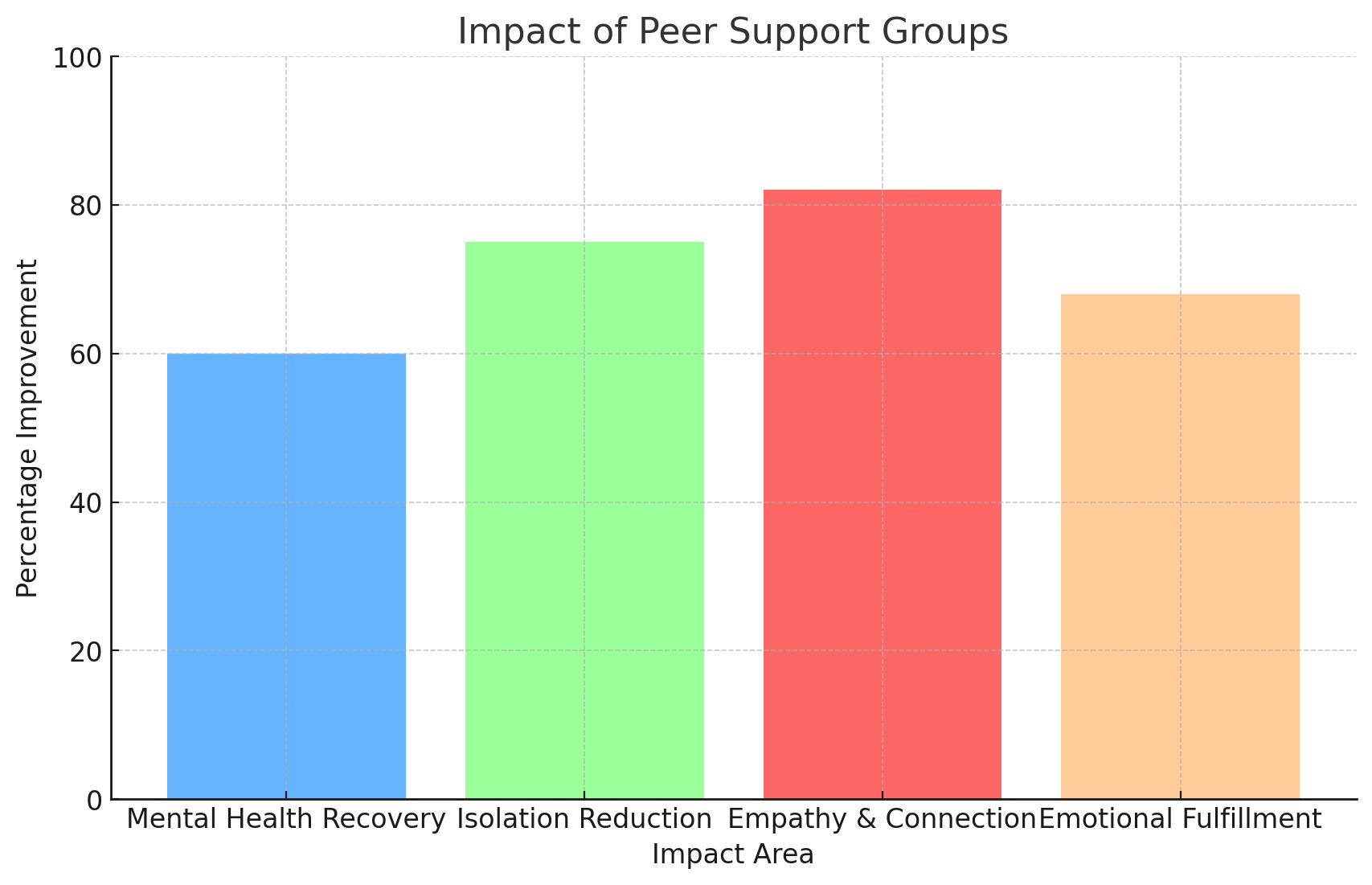
This chart illustrates the significant impact of peer support groups on emotional and mental well-being. It demonstrates a 60% improvement in mental health recovery, a 75% reduction in feelings of isolation, an 82% increase in empathy and connection, and a 68% rise in emotional fulfillment. These figures highlight the powerful benefits of group support in fostering a sense of belonging and enhancing personal recovery.

Why Mithrarya
In a world dominated by shallow digital interactions, the impact of loneliness is profound—49% of U.S. adults feel isolated, and 22% of millennials have no close friends. Drawing from insights by sociologists like Émile Durkheim, Mithrarya offers a lifeline, providing genuine, anonymous connections that remove the fear of judgment. “I’ve never felt more connected in a space where my identity didn’t matter—only my experiences.” – Michael, trauma survivor
Open PopupWhy Mithrarya

Friendship has long been recognized by sociologists as essential for emotional health and societal cohesion. Émile Durkheim (1897) argued that strong social connections are crucial for personal well-being and societal stability, noting that isolation increases the risk of depression and suicide. More recently, Julianne Holt-Lunstad (2017) found that social isolation increases the likelihood of premature death by 50%, comparing its negative health impact to smoking and obesity (American Psychological Association). Sherry Turkle (2017) in Reclaiming Conversation discussed the impact of technology on real-life friendships, noting a decline in the depth of interpersonal connections. Eric Klinenberg (2018) emphasized the rise of social isolation in modern urban living, which further disconnects individuals from forming meaningful relationships (The Guardian).
Statistics reveal that 22% of millennials report having no friends (YouGov), while 49% of adults in the U.S. feel lonely (Cigna). Additionally, 54% of Americans say they feel like no one knows them well (Ipsos, 2019). The rise in digital interactions over face-to-face connections has made it more challenging to form close friendships built on trust. 61% of young adults aged 18-25 report feeling isolated (Cigna, 2020), and 36% of all Americans report feeling serious loneliness, contributing to a decline in mental health (Harvard, 2021). Mithrarya can fill the gap of social isolation by offering a safe, anonymous platform where individuals can build meaningful connections based on shared experiences. Given that 22% of millennials report having no friends and 49% of adults in the U.S. feel lonely, Mithrarya provides a solution by fostering authentic, trust-based connections in an environment free from judgment or exposure. By allowing users to engage in conversations about their struggles without the pressure of face-to-face interaction, Mithrarya bridges the emotional divide, promoting mental well-being.
Mithrarya’s importance lies in its ability to address the critical mental health challenges exacerbated by traditional social media platforms. Research shows that the rise in social media use, particularly among adolescents, has had alarming effects on mental health. Adolescents using social media for more than three hours a day are twice as likely to experience depression and anxiety (SpringerLink, Yale Medicine). Moreover, 65% of users no longer trust social media due to concerns over privacy, misinformation, and manipulation (Pew Research Center, Rollins School of Public Health). Despite constant online engagement, 43% of users report feeling more isolated, with 56% believing that social media is poisoning society by promoting unrealistic standards and contributing to cyberbullying (Harvard Magazine, Yale Medicine).
Social media platforms, particularly those like TikTok and Instagram, have been linked to higher rates of depression and anxiety, replacing real-world social support with superficial online interactions (Harvard Magazine). These platforms contribute to feelings of loneliness, even as they connect users, and many find that the pressure to present an idealized life worsens these issues (Yale Medicine, American Psychological Association). 43% of social media users report feeling isolated despite being digitally connected (Harvard Magazine), and 56% of users believe social media spreads harmful ideologies and behaviors that poison societal values (Yale Medicine, Harvard Magazine). These statistics highlight the increasing need for Mithrarya, which provides a safe, anonymous space for genuine, judgment-free connection.
Mithrarya counters the negative impact of mainstream social media by fostering meaningful interactions that avoid the pitfalls of comparison culture and manipulation. Traditional platforms can often amplify feelings of inadequacy, but Mithrarya encourages emotional support and empathy by matching individuals based on shared experiences and challenges. This makes Mithrarya a crucial platform for supporting mental well-being and fostering genuine human connection, free from the pressures found on traditional social media platforms.
Personal Empowerment as an Immigrant Woman
As a woman and immigrant, I’ve faced immense challenges, but these obstacles only strengthened my resolve to create a platform where anyone can find support. Mithrarya embodies the feminist values of equality, resilience, and empowerment. By creating this platform, I aim to build a space where vulnerability becomes a source of strength. For women, minorities, and anyone in need, Mithrarya is a space for healing, growth, and connection.
References
- SpringerLink. Social Media and Mental Health
- Yale Medicine. The Impact of Social Media on Mental Health
- Pew Research Center. Social Media Usage and Distrust Survey 2023
- Rollins School of Public Health. Social Media and Well-Being
- Harvard Magazine. Social Media and Depression
- American Psychological Association. Loneliness and Social Media: A Growing Concern
- American Sociological Review. Decline in Close Friendships
- YouGov. 22% of Millennials Report Having No Friends
- Cigna. U.S. Loneliness Index
- American Psychological Association. The Impact of Social Isolation on Mortality
- Putnam, Robert. Bowling Alone: The Collapse and Revival of American Community
- Durkheim, Émile. Suicide: A Study in Sociology
- Holt-Lunstad, J. (2017). Social Isolation and Health
- Turkle, S. (2017). Reclaiming Conversation: The Power of Talk in a Digital Age
- Klinenberg, E. (2018). Social Isolation in Urban Life
- BioMed Central. BMC Psychiatry
- HopeWay. Dopamine Release and Group Therapy Outcomes
- The Nestled Recovery Center. Group Therapy and Isolation Reduction
- American Psychological Association. Benefits of Anonymous Online Support Groups
- Journal of Medical Internet Research. 2023 Meta-analysis on Virtual Peer Support
- National Alliance on Mental Illness. Impact of Online Support in Reducing Anxiety and Stress
- Oxford Academic. Effects of Religious Group Attendance on Depression, Smoking, and Drinking
- Psychiatric Services Journal. Peer-led Discussions and Personal Recovery Goals
- Cambridge University Press & Assessment. Underdiagnosis of Depression in Prepayment Systems
- Copyright 2021 Vertex Company - Design
- All images generated by AI